
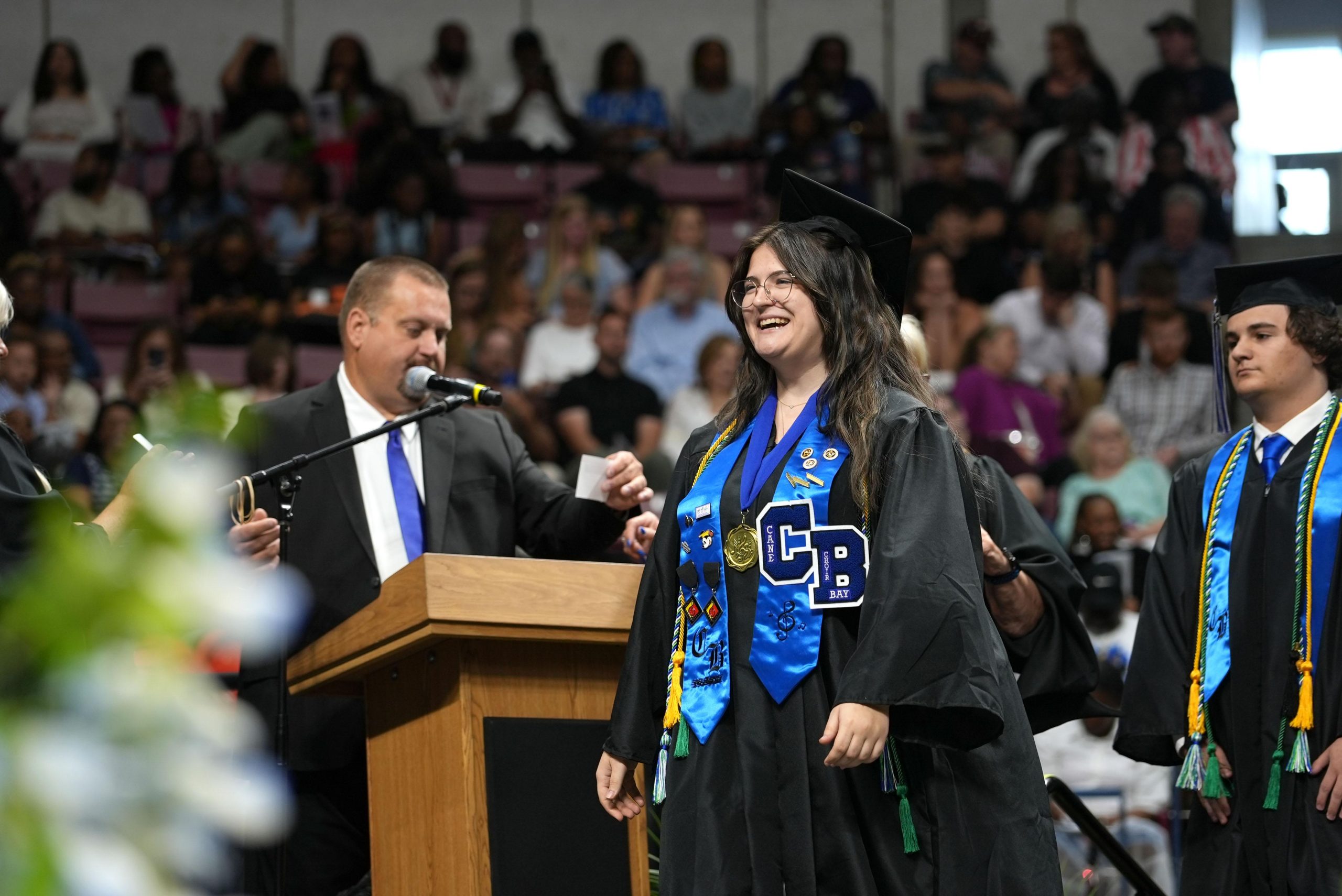
Graduation name pronunciation matters. After years of hard work, students walk across the stage, hear their names announced and receive recognition in front of family, friends and teachers. Getting those names right is one of the most important parts of the ceremony.
Getting that name right matters.
Yet many high schools, colleges and universities still rely on an old-school approach: asking graduates to provide phonetic spellings of their names, printing them on reader cards and hoping the announcer interprets them correctly.
There’s a better way.
By combining phonetic spelling with graduate-verified audio pronunciations, schools can give their announcers the confidence to get names right. And for institutions that want an additional level of consistency, automated name announcements can play the exact pronunciation a graduate has already approved.
When Graduation Name Pronunciation Goes Wrong
In May 2024, Thomas Jefferson University’s nursing graduation made national headlines after an announcer repeatedly mispronounced graduates’ names.
Even familiar names, including Thomas and Elizabeth, became almost unrecognisable. Video clips circulated widely on social media, and the university subsequently apologised.
The university explained that the mistakes arose from the way phonetic spellings had been presented on the speaker’s cards.
For graduates, a moment they had worked towards for years became memorable for the wrong reasons.
The incident highlights a problem with traditional graduation name reading: phonetic spellings alone aren’t always enough.
Read CBS News’ coverage of the Thomas Jefferson University incident.
Why Phonetic Name Spellings Can Be Unreliable
A phonetic spelling attempts to represent how a name should sound using written letters and syllables.
For example, a graduate might write their name as a series of syllables, capitalising the part that should receive emphasis.
It’s a familiar approach, and it can be helpful. But it has limitations.
Different readers may interpret the same spelling differently. Written phonetics don’t always communicate the rhythm, emphasis or subtle sounds of a name, particularly when the name originates from a language unfamiliar to the announcer.
And graduation readers are often expected to announce hundreds of names, sometimes with little opportunity to practise beforehand.
A phonetic spelling is a useful reminder. It shouldn’t be the only way an announcer learns a graduate’s name.
The Better Approach: Listen. Learn. Repeat.
Think about how we naturally learn to pronounce someone’s name correctly.
We listen to them say it. We repeat it. If we get it wrong, they correct us.
Graduation name pronunciation software can bring that same process to an entire graduating class.
Rather than expecting announcers to decode unfamiliar phonetic spellings in real time, schools can collect and verify name pronunciations before the ceremony.
With StageClip’s NameCheck, the process is straightforward:
- Generate pronunciations. The school uploads its graduate names, and NameCheck creates AI-generated audio pronunciations and phonetic spellings.
- Let graduates verify them. Each graduate listens to their name and confirms whether it sounds right.
- Make corrections where needed. Graduates can adjust the pronunciation, change the accent or record themselves saying their name.
- Prepare the announcers. Readers can access approved audio, phonetic spellings and name lists, giving them time to listen, learn and practise before graduation day.
The result is a more reliable preparation process that puts graduates in control of how their names should be pronounced.
Why Graduate Verification Is So Important
AI-generated pronunciations are a useful starting point. But even sophisticated technology can get names wrong.
A name may have several accepted pronunciations. A graduate may prefer a pronunciation that reflects their family’s language or cultural background. And two people with the same spelling may pronounce their names differently.
That’s why graduate verification matters.
NameCheck allows students to listen to their proposed pronunciation and approve it or make changes.
If the pronunciation isn’t right, they can adjust the spelling used to generate the audio, select a different accent or record their own voice.
NameCheck can then convert the graduate’s recording into a consistent AI-generated voice, so it matches the other announcements.
The graduate isn’t simply providing a name. They’re helping determine exactly how it should be announced.
What Gonzaga University Discovered
When Gonzaga University used StageClip’s NameCheck, 32% of graduates who reviewed their name pronunciations made corrections.
That’s almost one in three students who identified something they wanted changed before their names were announced.
It’s a compelling reason not to assume that the first pronunciation generated by AI — or written on a phonetic card — will necessarily be correct.
Graduate verification gives schools an opportunity to resolve those issues before anyone reaches the stage.
Keep Your Live Announcers — Just Give Them Better Preparation
Not every school wants automated name announcements.
For many high schools, having a familiar teacher, principal or member of staff read graduates’ names is an important part of the ceremony.
NameCheck is designed to support that approach.
Announcers can listen to approved recordings, practise unfamiliar names and use automatically generated phonetic spellings as a backup.
Schools can also work from downloadable or printable name lists and use a reader practice interface.
It’s a practical solution for institutions that want better name pronunciation without investing in a full commencement management platform.
And with NameCheck priced at $1 per graduate, a high school with 300 graduates would pay approximately $300, subject to applicable purchasing terms.
Want Even Greater Consistency? Scan the Card and Play the Approved Name
For schools that want to reduce the risk of live pronunciation mistakes further, there’s another option.
StageClip’s NameCue combines graduation card scanning, big-screen name display and optional automated name announcements.
As each graduate approaches the stage, an usher scans their barcode card.
NameCue can then display the graduate’s name on the venue’s big screen and play their approved, prerecorded announcement through the PA system.
That means the announcement uses the pronunciation the graduate has already reviewed, rather than a reader attempting an unfamiliar name for the first time.
The Plano ISD Experience
Plano Independent School District in Texas provides a practical example of this approach at high-school graduation ceremonies.
Rather than relying on live announcers to read every name, Plano used StageClip’s scanning technology to trigger prerecorded name announcements as graduates approached the stage.
It’s an example of how schools can combine graduate verification with card scanning to deliver a more consistent graduation experience.
Explore NameCheck and NameCue.
Even Automated Announcements Need a Backup Plan
Graduate-approved recordings can significantly reduce the uncertainty of live name reading. However, reliable ceremony delivery still requires careful preparation.
Schools should test their scanning equipment, name displays, audio playback and AV integration before graduation day, with a backup procedure in place if anything goes wrong.
The aim is simple: ensure every graduate hears their correctly pronounced name when they cross the stage.
Phonetic Spelling vs Audio Pronunciation vs Automated Announcements
| Approach | Advantages | Limitations |
|---|---|---|
| Phonetic name cards | Familiar, simple and inexpensive | Open to interpretation; difficult names may still be mispronounced |
| Graduate-verified audio with live announcers | Graduates approve pronunciations; readers can practise; retains the personal touch | Requires preparation and reader practice |
| Card scanning with prerecorded announcements | Consistent approved audio; automatic name display; reduces live reading errors | Requires scanning equipment, AV integration and a backup plan |
For many schools, the most practical solution is graduate-verified audio with live announcers.
For others, particularly larger ceremonies or events requiring automated stage recognition, scanning and prerecorded announcements provide an additional option.
Both approaches benefit from getting the pronunciation right before graduation day.
How Can Schools Improve Graduation Name Pronunciation on a Budget?
You don’t need an expensive, all-in-one commencement management platform to improve name pronunciation.
A school with a limited budget can start with NameCheck, collect graduate-approved pronunciations and give its announcers time to listen, learn and repeat.
Phonetic spellings remain available as a useful backup.
Schools that want big-screen name display or automated name announcements can add NameCue.
This flexible approach makes graduation name pronunciation technology accessible to high schools, school districts, community colleges and universities of different sizes.
Frequently Asked Questions
How do you pronounce difficult names at graduation?
The most reliable preparation is to ask graduates to verify how their names should be pronounced. Announcers can then listen to approved recordings and practise before the ceremony, using phonetic spellings as a backup.
Can you generate phonetic spellings of names for graduation?
Yes. NameCheck automatically generates phonetic spellings alongside AI audio pronunciations. Graduates can review their pronunciation and make corrections before the ceremony.
Is phonetic spelling enough for graduation name reading?
Not always. Phonetic spellings can be interpreted differently by different readers. Audio recordings provide an additional reference for pronunciation, emphasis and rhythm.
Can graduates record their own name pronunciation?
Yes. With NameCheck, graduates can record themselves saying their name. Their recording can also be converted into an AI-generated voice for consistent ceremony announcements.
Can schools automatically announce graduate names?
Yes. NameCue allows schools to scan graduate cards, display names on the big screen and optionally play approved, prerecorded name announcements through the venue’s PA system.
How much does graduation name pronunciation software cost?
StageClip’s NameCheck costs $1 per graduate. Schools can explore the platform before committing, and NameCue is available as an additional ceremony solution.
Every Graduate Deserves to Hear Their Name Pronounced Correctly
Graduation is a celebration of individual achievement. Getting a graduate’s name right is one of the simplest and most meaningful ways to recognise that achievement.
Phonetic spellings have their place. But today’s schools don’t have to rely on written approximations and last-minute guesswork.
With graduate-verified audio, announcers can listen, learn and repeat. And with optional card scanning and automated announcements, schools can take an additional step towards consistent graduate recognition.
Give graduates confidence that their names will be pronounced correctly — and give your school confidence that it’s prepared.
Explore NameCheck — Graduation Name Pronunciation from $1 per Graduate